Our assumptions
China's advantage comes from its system, far more than from wage gaps or privileged access to resources.
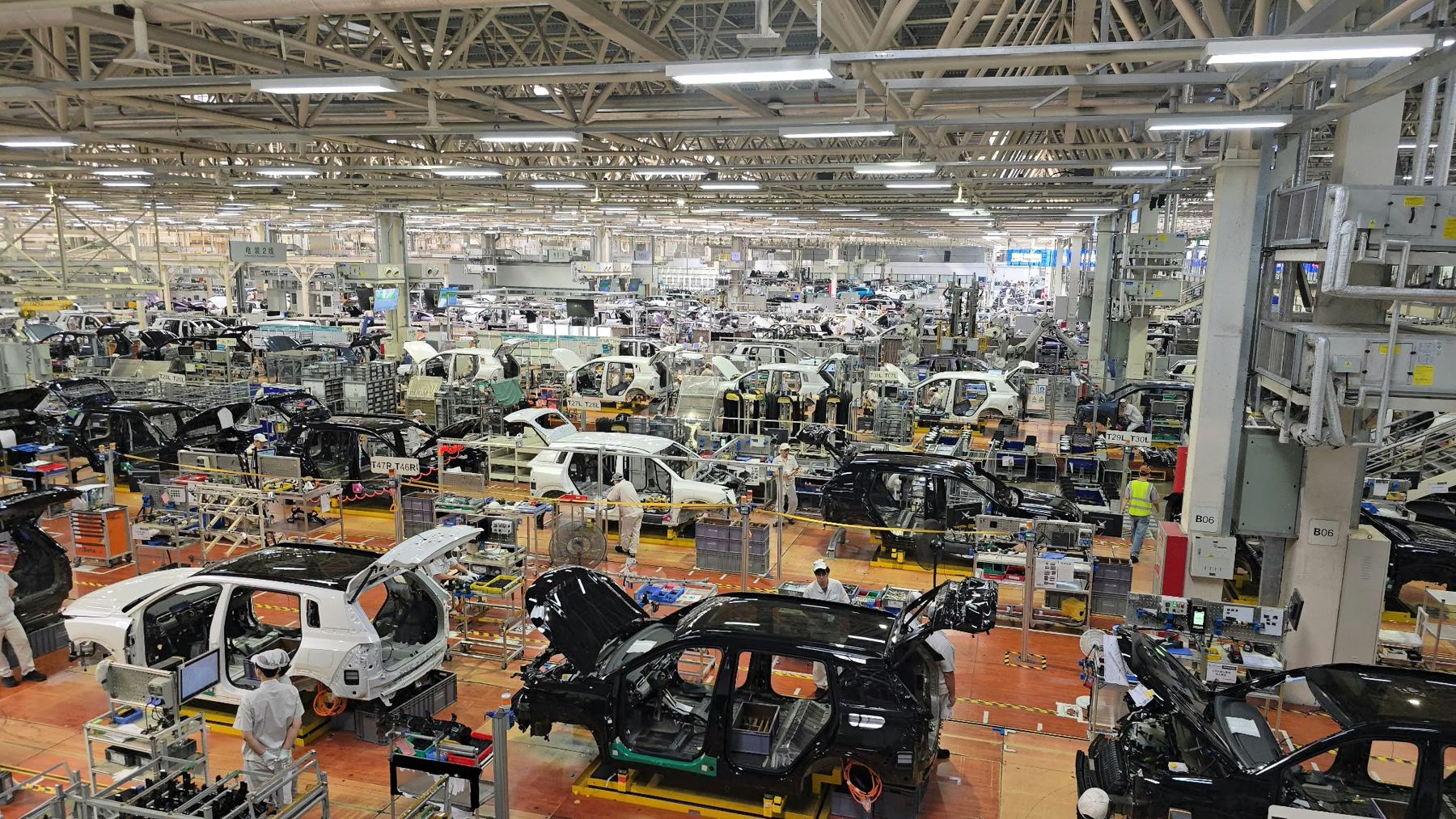
Many of us still had the image of the workshop of the world: abundant labour, low costs, products copied before being improved. Three figures are enough to challenge it.
Automated plants that design their own machines
Wages explain only part of the gap
For a long time, the reflex was to put the performance gap down to labour costs. Labour is indeed far cheaper in China than in Western Europe. A production worker there earns around €900 a month on average4, less than half the gross minimum wage in France (€1,823) or Germany (€2,343)5. At the large employers in the bay area, the operators we spoke to earn between €1,000 and €1,200.
It does not hold everywhere in Europe
It says nothing about speed
It weighs little on an automated line
According to Roland Berger, around 60% of the cost gap comes from design and production-system architecture decisions. For the firm, Chinese speed results from decisions on product design, range complexity and the supplier base6.
Automotive, production cost in Europe = 100. Axis narrowed to 70 to 100 to show the gap.
OSS calculation based on Roland Berger, automotive sector. The central values (−15, −10) are derived from the published range of 20 to 30%. Source: Roland Berger, China Speed, March 2026.
They design their own chips and cameras
Subsidies matter, without explaining everything
According to CSIS, China spends at least 1.73% of its GDP on industrial policy8. In 2024, the European Union imposed countervailing duties of up to 35.3% on its electric vehicles9. Appendix E details this support. It explains part of the price gap. It does not explain development cut from 40 months to 24. It sits within a system where the state sets the direction and shares the risk, described in chapter 3.
Chinese groups are arriving in Europe, and the next sectors are already named
In detail
Other European studies point the same way.
- France's Haut-commissariat à la Stratégie et au Plan measures cost gaps of 30 to 40% at comparable quality. It describes a coherent industrial system that is hard to reproduce in the short term10, and draws public responses from it: tariffs or a weaker euro.
- BCG estimates that nearly $1,000 billion of manufacturing value could leave Western Europe without transformation.
- The Mercator Institute for China Studies names the next sectors at risk: semiconductors, machine tools, IT equipment, medical devices and pharmaceuticals11.
- According to Rhodium Group, German carmakers are already cutting jobs at the fastest pace since 200812.
The public framework, for its part, moves slowly. Almost two years after the Draghi report, around 30% of its 567 recommendations have been implemented13. Our study does not contradict these diagnoses. It adds that part of the gap comes down to decisions every company can take without waiting.
The advantage lies in the system
At Shein's innovation centre in Guangzhou, we were told that the resources of the Chinese supply chain, meaning fabrics, factories and logistics, are open to other brands. The advantage Shein claims lies in its integrated system, its models and the way it manages its suppliers14.
If the advantage came from reserved access, we could do nothing. It comes from decisions about the system, so part of it can be reproduced.
1. IFR, World Robotics 2026, press release of 24 September 2026.
2. McKinsey, Automotive product development, August 2025.
3. BCG, The Factory of the Future Is Redrawing the Competitive Map of Global Manufacturing, June 2026: about $1.03 trillion in Western Europe and the Nordic countries.
4. National Bureau of Statistics of China, average wages 2025; converted at 7.47 yuan to €1.
5. Eurostat, minimum wages at 1 January 2026.
6. Roland Berger, China Speed, March 2026.
7. World Economic Forum, Global Lighthouse Network, June 2026; breakdown by country from CGTN, 24 August 2026.
8. CSIS, Red Ink, May 2022: conservative estimate, excluding instruments that cannot be quantified.
9. European Commission, Implementing Regulation (EU) 2024/2754.
10. Haut-commissariat à la Stratégie et au Plan, L'industrie européenne face au rouleau compresseur chinois, February 2026.
11. MERICS, Concurrence chinoise : l'Europe sous pression (A. Vasselier).
12. Rhodium Group, February 2026, cited by the German Marshall Fund.
13. Institut Montaigne, Rapport Draghi : l'Europe au rendez-vous ?, June 2026.
14. Visit to Shein's innovation centre, Guangzhou, 28 October 2026.
D. Figure presented by the company during the visit: full status on the status of figures page.